
Why is social-emotional learning (SEL) important?
SEL is important because it teaches students to cultivate positive prosocial traits, such as empathy, compassion, self-awareness, self-control, and responsible decision-making (Yale School of Medicine, 2023). Frequently, these traits are the core components of foundational SEL curriculum.
Empathy and Social Awareness
SEL trains students to understand others by stepping into their shoes. SEL helps students deepen their perspective of the world by giving them the space to explore different cultures and discuss ideas from multiple angles.
Self-awareness
SEL trains students to critically assess their feelings, concerns, values, and strengths. As a result, this ability allows students to deepen self-confidence and self-understanding. Students learn what works best for them in regulating their emotions, controlling impulses, and persevering to reach their goals amidst challenges.
Decision-making
SEL trains students to make their own decisions responsibly as they take into consideration ethical standards, safety concerns, social etiquette, and respect for others and the environment. Students can apply responsible decision-making to contribute to the well-being of their community and, ultimately, of society.
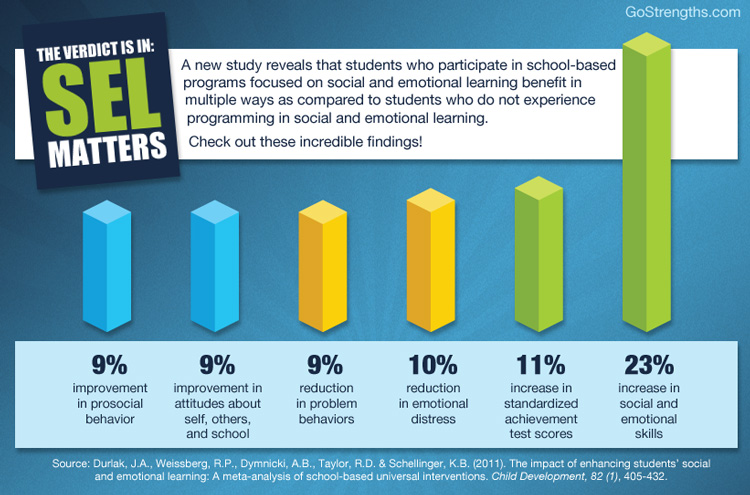
SEL benefits not only social and emotional development but also cognitive development and academic performance. SEL teaches students various life skills, such as stress management, problem-solving, resisting negative peer pressure to engage in harmful activities, and building strong connections with others. As students learn these life skills, they tend to perform better at school. In fact, students who participated in SEL programs saw an 11 percent increase in their overall grades and school attendance (Durlak et al., 2011).
Recommended Readings
- Yale School of Medicine. (2023, July 14). Research finds social and emotional learning produces significant benefits for students.
- Durlak, J.A., Weissberg, R.P., Dymnicki, A.B., Taylor, R.D., & Schellinger, K.B. (2011). The impact of enhancing students’ social and emotional learning: A meta-analysis of school-based universal interventions. Child Development, 82, 405-432.
- Technical Report: Findings from Three Scientific Reviews: The Positive Impact of Social and Emotional Learning for Kindergarten to Eight-Grade Students. Published in December 2008.
- Lawson, G. M., McKenzie, M. E., Becker, K. D., Selby, L., & Hoover, S. A. (2019). The Core Components of Evidence-Based Social Emotional Learning Programs. Prevention science : the official journal of the Society for Prevention Research, 20(4), 457–467.
 Empathify
Leave a comment